“What does ‘full of grace’ mean?” “Why do we ask Mary to pray for us?”
Children may learn the words of the Hail Mary before they understand them. Their questions give us an opportunity to explore the prayer together.
You do not need to explain everything at once. Start with one phrase, connect it to something your child understands, and leave room for questions. This guide will help you work through the prayer one line at a time.
What Is the Hail Mary Prayer?
The Hail Mary is a Catholic prayer that honours Mary, the mother of Jesus, and asks her to pray for us.
Its opening words draw on two passages in the Bible: the angel Gabriel’s greeting to Mary in Luke 1:28, and Elizabeth’s blessing of Mary and Jesus in Luke 1:42. The second part asks for Mary’s prayers now and at the end of our lives.
For a young child, you can begin with this explanation:
“When we pray the Hail Mary, we remember that Mary is Jesus’ mother and ask her to pray to God for us.”
1. “Hail Mary, full of grace”
What does it mean?
“Hail” is an old-fashioned greeting. “Full of grace” tells us that Mary is filled with God’s grace, His freely given love and help.
When the angel Gabriel greeted Mary, he brought the news that she would become the mother of Jesus. God’s grace prepared her for this calling, and Mary responded with faith.
Explain it to your child
“We begin by greeting Mary. God filled her life with His love and helped her become Jesus’ mother. Mary trusted God and said yes to Him.”
Talk about it together
“What did God ask Mary to do?”
Let your child answer in their own words. You can then talk about how Mary trusted God even though she had questions.
2. “The Lord is with thee”
What does it mean?
“The Lord” means God. “Thee” is an old word for “you.”
This phrase means “God is with you.” Gabriel’s greeting reassured Mary that she was not alone in what God was asking of her.
It also gives families an opportunity to talk about trusting God during unfamiliar or difficult moments.
Explain it to your child
“The angel told Mary that God was with her. She did not know everything that would happen, but she could trust Him. We can also turn to God when we feel happy, worried or unsure.”
Talk about it together
“When would you like to ask God for courage or help?”
Your child might mention starting school, making a friend or trying something new. Listen first, then offer a short prayer together.
3. “Blessed art thou among women”
What does it mean?
“Art thou” means “are you.” The phrase tells Mary that she is blessed among women.
Elizabeth spoke these words when Mary visited her. Mary had received a unique blessing: she would be the mother of Jesus. Elizabeth also praised Mary for believing God’s promise.
This does not mean that other women are unimportant or unloved. It recognises Mary’s particular place in God’s plan.
Explain it to your child
“Elizabeth was joyful when Mary came to visit. She knew that Mary had been chosen to be Jesus’ mother. Mary believed God’s promise and welcomed what He asked of her.”
Talk about it together
“Why was Elizabeth happy to see Mary?”
If your child enjoys stories, read or retell the visit from Luke 1:39–45.
4. “And blessed is the fruit of thy womb, Jesus”
What does it mean?
“Thy” means “your.” A womb is the part of a mother’s body where a baby grows before birth.
“The fruit of thy womb” refers to the child Mary was carrying: Jesus. In this line, we honour Him by name.
Jesus is the Son of God, who became human and came to save us and bring us close to God.
Explain it to your child
“These words are about Jesus, who grew in Mary’s womb before He was born. We say His name because Jesus is at the heart of this prayer. He is God’s Son, and He shows us God’s love.”
Talk about it together
“What is something you remember about Jesus from a Bible story?”
Give your child time to recall a story. You could talk about Jesus welcoming children, helping someone in need or teaching people to love one another.
5. “Holy Mary, Mother of God”
What does it mean?
We call Mary “holy” because of God’s grace and her faithful response to Him.
“Mother of God” can sound puzzling to children. Catholics use this title because Mary is the mother of Jesus, and Jesus is truly God and truly human.
It does not mean that Mary created God or existed before Him. It tells us who Jesus is.
Explain it to your child
“Mary is Jesus’ mother. Jesus is both God and human, so we call Mary the Mother of God. She did not make God begin to exist. She gave birth to Jesus and cared for Him as He grew.”
Talk about it together
“How do you think Mary cared for Jesus when He was a child?”
You might discuss feeding Him, comforting Him and keeping Him safe. Explain that imagining everyday family moments can help us remember that Jesus really became human.
6. “Pray for us sinners”
What does it mean?
Here we ask Mary to pray for us.
“Sinners” means that we need God’s forgiveness for the wrong choices we make. An accident, a difficult feeling or an incorrect answer at school is not the same as choosing to do something wrong.
Asking Mary to pray for us is called intercession. Just as we can ask a friend or family member to pray for us, Catholics ask Mary for her prayers.
Catholics worship God alone. We honour Mary and ask her to help us draw closer to Jesus through her prayers.
Explain it to your child
“Sometimes we choose to do something wrong, such as deliberately being unkind. God still loves us. We can ask for forgiveness, put things right and ask for help to make better choices. In this prayer, we ask Mary to pray for us.”
Talk about it together
“Who would you like Mary to pray for today?”
Your child might name a friend, someone who is ill, a family member or themselves.
7. “Now and at the hour of our death”
What does it mean?
We ask Mary to pray for us right now and when our earthly lives end.
This line expresses trust that we can turn to God throughout our lives, including at death. Catholics believe in the resurrection and hope for eternal life with God.
Explain the words calmly and simply. There is no need to introduce frightening details, but it helps to answer the question your child actually asks.
Explain it to your child
“We ask Mary to pray for us today and throughout our lives. We also ask her to pray for us when our lives on earth end. We can tell God about our worries and trust in His love.”
Talk about it together
“Is there anything in this line that you would like to ask about?”
Let your child guide the conversation. It is fine to say, “That is a big question. Let’s talk about it together.”
8. “Amen”
What does it mean?
“Amen” expresses agreement and trust. It means something like “So be it” or “Truly.”
At the end of the Hail Mary, it is our way of affirming the prayer we have just said.
Explain it to your child
“When we say ‘Amen,’ we mean the words we have prayed. It is a little word that expresses our trust in God.”
Talk about it together
“What did we ask Mary to do for us in this prayer?”
Help your child recall the central request: to pray for us now and at the hour of our death.
The Complete Hail Mary Prayer
Read the prayer together slowly. Your child can join in with the words they know.
Hail Mary, full of grace,
The Lord is with thee.
Blessed art thou among women,
And blessed is the fruit of thy womb, Jesus.Holy Mary, Mother of God,
Pray for us sinners,
Now and at the hour of our death.
Amen.
Some families use “you” and “your” instead of “thee,” “thou” and “thy.” If your child hears a different version at church or school, explain that these words have the same meaning.
A Five-Minute Hail Mary Activity for Families
You can use this activity at bedtime, after dinner or during another quiet moment.
- Choose one line. Read it aloud slowly.
- Ask what your child notices. Is there an unfamiliar word or something they wonder about?
- Explain it simply. Use the child-friendly explanation above, adapting it to their age.
- Make it personal. Name someone to pray for, share a worry with God or think of something to put right.
- Pray together. Say the Hail Mary, pausing briefly at the line you explored.
Try one line each day. There is no need to test your child or expect them to remember every explanation.
Explore the Prayer Through a Story
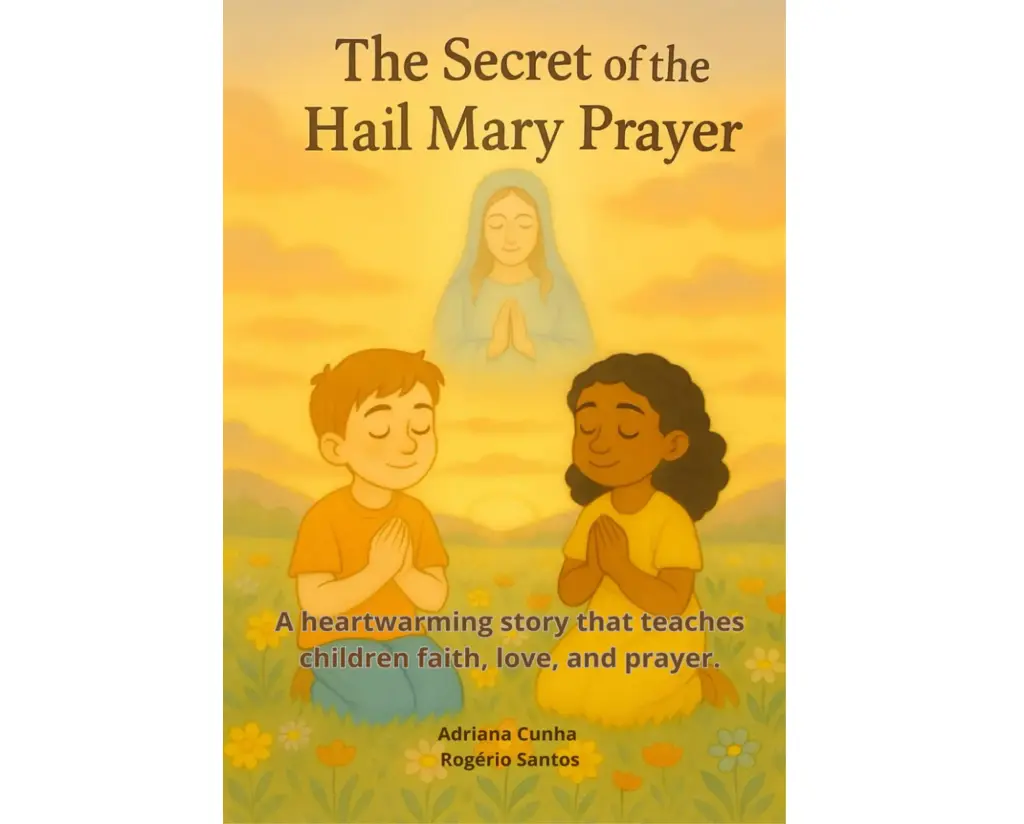
The Secret of the Hail Mary Prayer
An illustrated introduction to the Hail Mary for children ages 4–10, by Adriana Cunha and Rogério Santos.
Read it together alongside this guide, pausing to talk about the prayer and what it means in your family’s life.
Explore the BookFrequently Asked Questions
At what age can children learn the Hail Mary?
There is no single starting age. Young children can listen and join in with a few words when they feel ready. Introduce the meaning gradually, following their questions and attention span.
How do I explain the Hail Mary to a five-year-old?
Start with three ideas: Mary is Jesus’ mother, God was with her, and we ask her to pray for us. Explore one short phrase at a time rather than expecting your child to understand the whole prayer in one sitting.
Is the whole Hail Mary in the Bible?
No. The opening part draws on Gabriel’s greeting in Luke 1:28 and Elizabeth’s words in Luke 1:42. The second part developed in the Church’s prayer tradition as a request for Mary’s intercession.
Do Catholics worship Mary?
No. Catholics worship God alone. We honour Mary as the mother of Jesus and ask her to pray for us. The distinction can be explained simply: “We ask Mary to pray to God with us and for us.”
Begin With One Line Tonight
Choose one phrase, ask one question and listen to your child’s answer. Finish by praying together.
You do not need to have every answer ready. Making space for your child’s questions is a useful beginning.
For parents and catechists: see Luke 1:26–45 and the Catechism of the Catholic Church, paragraphs 2676–2677, for further background on the prayer.