“Why is baby Jesus sleeping in a place where animals eat?”
A child looking at a Nativity scene might notice the manger before anything else. It is an unusual place for a newborn baby—and an important detail in Luke’s account of Jesus’ birth.
Luke tells us that Mary wrapped Jesus in cloths and laid Him in a manger because there was no room for them in the lodging place. A manger is a feeding trough for animals.
Christians see humility in this scene: Jesus, whom the angels announce as Savior and Lord, begins His earthly life in simple circumstances.
Let’s explore what the Bible tells us, which details come from Nativity traditions, and how families can reflect on the story together.
The Christmas Story for Kids
Mary and Joseph Trust God
In Nazareth, a young woman named Mary received a surprising message. The angel Gabriel told her that she would have a son named Jesus. He would be the Son of God.
Mary had questions, but she trusted God and accepted what He asked of her. Matthew’s Gospel also tells us that an angel appeared to Joseph in a dream, reassuring him about Mary and the child. Joseph followed the angel’s instruction and took Mary as his wife.
Jesus Is Born in Bethlehem
Luke describes Mary and Joseph traveling to Bethlehem for a census. While they were there, the time came for Mary to give birth.
She wrapped Jesus in cloths and laid Him in a manger because there was no room for them in the lodging place. Luke does not describe an innkeeper or say that Jesus was born immediately after they arrived.
For a young child, you can keep the explanation simple: “Mary cared for baby Jesus and laid Him in a manger, a place normally used to hold food for animals.”
The Shepherds Hear the Good News
Nearby, shepherds were watching their sheep at night when an angel appeared. The angel announced that the Savior had been born in Bethlehem. The baby wrapped in cloths and lying in a manger would be their sign.
Then many angels praised God. The shepherds hurried to Bethlehem, found Mary, Joseph, and the baby, and shared what they had been told. They returned praising God.
The Wise Men Come to Honor Jesus
Matthew tells us about wise men from the East who followed a star in search of the child born King of the Jews. They honored Jesus and offered gold, frankincense, and myrrh.
Matthew describes them entering a house. He does not say they visited the manger on the same night as the shepherds. Nativity displays often bring these moments together to help us remember the whole Christmas story.
Why Was Jesus Laid in a Manger?
Luke gives a practical reason: there was no room for them in the lodging place. Translations use different wording, including “guest room” and “inn.” The account does not give us a detailed description of the building.
The Bible tells us what happened without explaining every reason for these circumstances. Christians have long reflected on the humility of Jesus’ birth and what it reveals about God coming close to us.
1. Our Worth Does Not Depend on What We Own
Jesus did not need a royal cradle to be the Son of God. His humble beginning helps children see that expensive things, popularity, and status do not determine a person’s worth.
Say it simply: “You do not need expensive things to matter. God loves you.”
Talk together: “Does someone need expensive things to be loved by God?”
2. God’s Good News Reaches Ordinary People
The shepherds were doing their everyday work when they heard the announcement. The good news reached them in the middle of an ordinary night.
Say it simply: “God’s love is not only for rich or famous people. Every person matters to Him.”
3. We Can Respond With Welcome
The Nativity can prompt us to notice people who need care and companionship. This is a way to respond to the story, without inventing someone who deliberately turned Mary and Joseph away.
A child might invite someone into a game, make a card for a lonely neighbor, or help a sibling. Choose one small action your family can actually do.
Talk together: “Who could we help feel welcome this week?”
4. Jesus Is at the Heart of Christmas
For Christians, Christmas celebrates the birth of Jesus, God’s Son, who became human and came as our Savior. This is why the manger matters: the baby in it is the one the angels announce as Lord.
Say it simply: “At Christmas, we celebrate God coming close to us in Jesus. We share kindness because He loves us—not to earn His love.”
A Nativity Drawing Activity for Kids
Set aside about 15–20 minutes for a family drawing activity. You only need paper, pencils, and crayons or markers. Younger children can draw simple shapes while you retell the story.
Step 1: Draw Jesus in the Manger
Draw a feeding trough with baby Jesus wrapped in cloths. You may draw the familiar wooden manger with hay, but explain that Luke does not tell us its material or exactly what it looked like.
Step 2: Add Mary and Joseph
Place Mary and Joseph beside Jesus. Talk about the care a newborn baby needs and the ways your family cares for one another.
Step 3: Draw the Shepherds
Add the shepherds coming to see Jesus. In a corner of the page, your child can draw the angel’s announcement to help tell the sequence of the story.
Animals, a stable, and a starry sky are familiar additions to Nativity pictures. Children may include them, while remembering that Luke does not list animals beside the manger or describe the building. If you add the wise men, explain that their visit belongs to a later part of the story.
Step 4: Choose One Act of Love
At the bottom of the drawing, help your child finish this sentence: “Because God loves us, this week I can…”
They might draw a handmade card, two children playing together, or someone helping at home. Choose an action they feel comfortable doing.
Step 5: Share and Pray
Ask your child to tell you about their picture. There is no need to correct every artistic detail or make it perfect.
Finish with a short prayer: “Jesus, thank You for coming into our world. Help our family welcome others and share Your love. Amen.”
Explore the Christmas Story Through Coloring
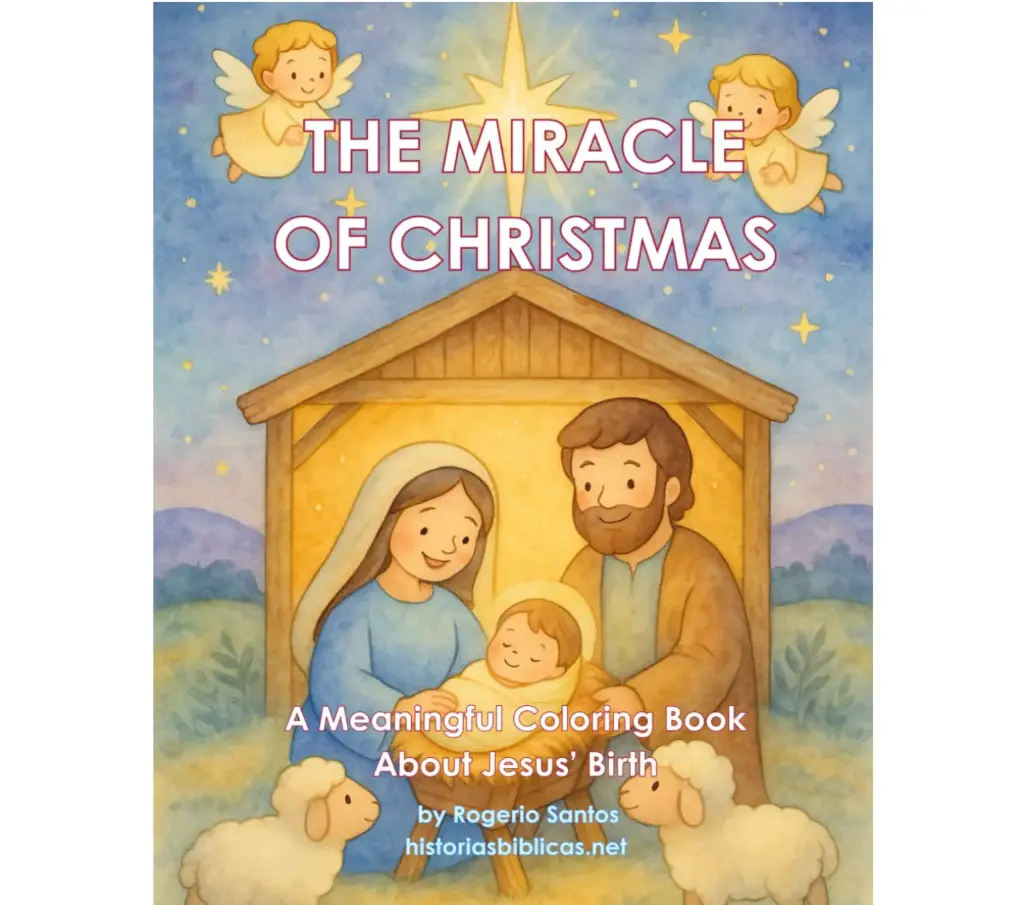
The Miracle of Christmas
A Meaningful Coloring Book About Jesus’ Birth combines simple Nativity storytelling with illustrations for children to color.
Use a page as a starting point for a quiet Advent or Christmas conversation: read together, color, and ask your child what they notice about the scene.
Explore the BookFrequently Asked Questions
Where was Jesus born?
Jesus was born in Bethlehem in Judea. Luke describes Mary laying Him in a manger, but does not specify the exact type of building.
Were there animals beside baby Jesus?
Luke mentions a manger, which was used to feed animals, but does not identify any animals present at the birth. Animals are a familiar part of Nativity art and tradition.
Did the shepherds and wise men visit together?
The Gospels do not describe a shared visit. Luke tells of the shepherds finding the baby in a manger. Matthew describes the wise men visiting Jesus in a house.
How can I explain Christmas to a 4- or 5-year-old?
Begin with a short explanation: “Christmas is when we celebrate Jesus’ birth. Mary cared for Him, and shepherds came after hearing the good news from an angel.” Use a picture, a song, or the drawing activity, and let your child’s questions guide the conversation.
Where can we read the Christmas story in the Bible?
Read Luke 2:1–20 for Jesus’ birth and the shepherds, and Matthew 2:1–12 for the wise men. Luke 1:26–38 describes Gabriel’s message to Mary, while Matthew 1:18–25 tells of Joseph’s dream.
Keep Jesus at the Center
You do not need an elaborate activity to help a child explore Christmas. Read a little of the story, listen to a question, and spend time together.
The heart of Christmas is Jesus: God’s Son becoming human and coming into our world as Savior. Our acts of kindness are a response to that love. A simple drawing and a shared prayer can help your family remember Him amid the celebrations.