“Why do Catholics ask Mary to pray for us? Can’t we just pray to God?”
Yes, we can always pray directly to God. Catholics also ask Mary for her prayers because they believe she is with Jesus in Heaven. Asking for her intercession means asking her to pray for us, not treating her as God.
This guide helps parents and catechists explain that distinction to children, with everyday examples and a ten-minute family activity. Choose one question at a time and let your child’s curiosity guide the conversation.
Who Is Mary, and Why Do Catholics Honour Her?
Mary is the mother of Jesus. In Luke 1:26–38, the angel Gabriel announces that she will have a son named Jesus, who will be called the Son of God. Mary asks a question and responds with faith.
Catholics honour her because of her unique role as Jesus’ mother and her example of trust in God. Mary is a human being, not a goddess.
Tell your child: “Mary is Jesus’ mother. She loved Him and trusted God. We honour her and learn from her example.”
Talk together: “What do you notice about Mary in the story of Gabriel’s visit?”
What Does Intercession Mean?
Intercession means praying for someone else. If a friend feels worried about school, you might ask God to give them courage and help them find support. You are interceding for your friend.
When Catholics ask Mary to pray for them, they are asking for her intercession. Asking Grandma or a friend to pray is a helpful starting comparison. The additional Catholic belief is that those who are with Christ in Heaven remain united with His Church.
Tell your child: “We can pray for other people, and we can ask other people to pray for us. Catholics believe Mary is with Jesus in Heaven and can pray for us too.”
Talk together: “Who would you like to pray for today?”
If We Can Pray Directly to God, Why Ask Mary?
Jesus taught His followers to pray to the Father. Children can speak to God in their own words, and they do not need Mary to persuade an unwilling God to listen.
Imagine your child is nervous about starting a new school. You pray together, then explain that a grandparent is praying too. The extra prayer expresses love and support; it does not mean God ignored the first prayer.
Catholics understand Mary’s prayers within the communion of saints: the Church’s life together in Christ, including the faithful in Heaven. Mary has a unique place as Jesus’ mother.
For adults: Catholic teaching holds that Mary’s intercession depends entirely on Christ and does not replace His unique role as Saviour and mediator. Asking for her prayers is an expression of trust in God, not an alternative to Him.
Do Catholics Worship Mary?
Catholic teaching reserves worship and adoration for God alone: the Father, Son and Holy Spirit. Honour for Mary is different from the worship given to God.
Children already know that they can love and respect someone without thinking that person is God. That familiar distinction is a starting point, although Mary’s place in Catholic devotion is unique.
Try these three simple sentences:
- We worship God.
- We honour Mary.
- We ask Mary to pray for us.
Talk together: “When we ask Mary to pray for us, who are we trusting to help us?”
How Does Mary Point Us Towards Jesus?
At the wedding in Cana, Mary notices that the hosts have run out of wine and brings their need to Jesus’ attention. She tells the servants to do what He tells them. Jesus performs the miracle (John 2:1–11).
Catholics see this story as an example of Mary’s concern for others and her trust in Jesus. It is not a promise that every request will be answered exactly as we expect.
Tell your child: “Mary noticed a need and brought it to Jesus. She teaches us to turn to Him and listen to Him.”
Talk together: “When someone needs help, how could we pray for them and offer practical care?”
What Does “Mother of God” Mean?
This title can sound puzzling. Catholics call Mary the Mother of God because she is the mother of Jesus, who is truly God and truly human.
It does not mean Mary created God or existed before Him. The title tells us who Jesus is. For a child, you might say: “Mary gave birth to Jesus and cared for Him. Jesus is God the Son, who became human.”
What Does “Pray for Us Sinners” Mean?
The Hail Mary asks: “Holy Mary, Mother of God, pray for us sinners, now and at the hour of our death. Amen.”
“Sinners” reminds us that we need God’s forgiveness for wrong choices. Deliberately being unkind is different from spilling a drink by accident, feeling angry or getting an answer wrong at school.
When we choose wrongly, we can ask forgiveness, put things right where possible and seek help to do better. God’s love is not a reward for never making a mistake.
The prayer asks for Mary’s prayers now and when our earthly lives end. Explain this calmly, answering the questions your child actually asks.
For the whole prayer and a fuller explanation, read our line-by-line Hail Mary guide for children.
A Ten-Minute Activity: The Family Prayer Heart
Ages: approximately 4–10, with adult support. Materials: paper and crayons. Adapt the writing and conversation to your child’s age.
1. Draw a heart
Draw a large heart and add the heading “People I Want to Pray For”. Younger children can draw pictures while an adult writes.
2. Choose people to remember
Invite your child to choose one to three people, such as a relative who is unwell, a worried friend or someone they want to thank God for. Add names, initials or drawings. Keep private details within the family.
3. Pray directly to God
Dear God, please care for the people we love. Give them strength, comfort and peace. Help us notice how we can care for them too. Amen.
Explain: “We have just prayed for other people. That is intercession.” Prayer is not a guarantee that an illness or difficulty will disappear, and it goes alongside the help people need.
4. Ask Mary for her prayers
In your family’s Catholic prayer, you could add this simple request:
Holy Mary, Mother of God, pray for us and for the people we love, that we may follow Jesus. Amen.
This is a short family prayer, rather than the complete Hail Mary. Remind your child that you are asking Mary to pray while placing your trust in God.
5. Choose one kind action
Ask: “Is there something we can do for one of the people we prayed for?” Make a card, offer help with a suitable task or arrange a friendly call with an adult. Prayer and loving action can go together.
For more ideas, try our five simple Hail Mary activities for children.
Questions Families Often Ask
Do Catholics pray to Mary instead of Jesus?
No. Catholics pray directly to God and also address Mary when asking for her prayers. Mary does not replace Jesus. In this context, “praying to Mary” means asking for her intercession, not worshipping her.
Does the Bible encourage praying for others?
Yes. James 5:16 and 1 Timothy 2:1 encourage prayer for others. These passages do not explicitly instruct Christians to address Mary in Heaven; Catholic devotion also draws on the Church’s teaching about the communion of saints.
Do all Christians ask Mary to pray for them?
No. Catholic and Orthodox traditions include asking Mary for her intercession, while many Protestant traditions do not. Explain your own family’s belief respectfully, without suggesting that children from another church love Jesus less.
What if my child still finds it confusing?
Return to one sentence: “We can always pray to God, and Catholics also ask Mary to pray for us.” You do not need to settle every question at once. Listen and revisit the conversation as your child grows.
Explore the Prayer Through a Story
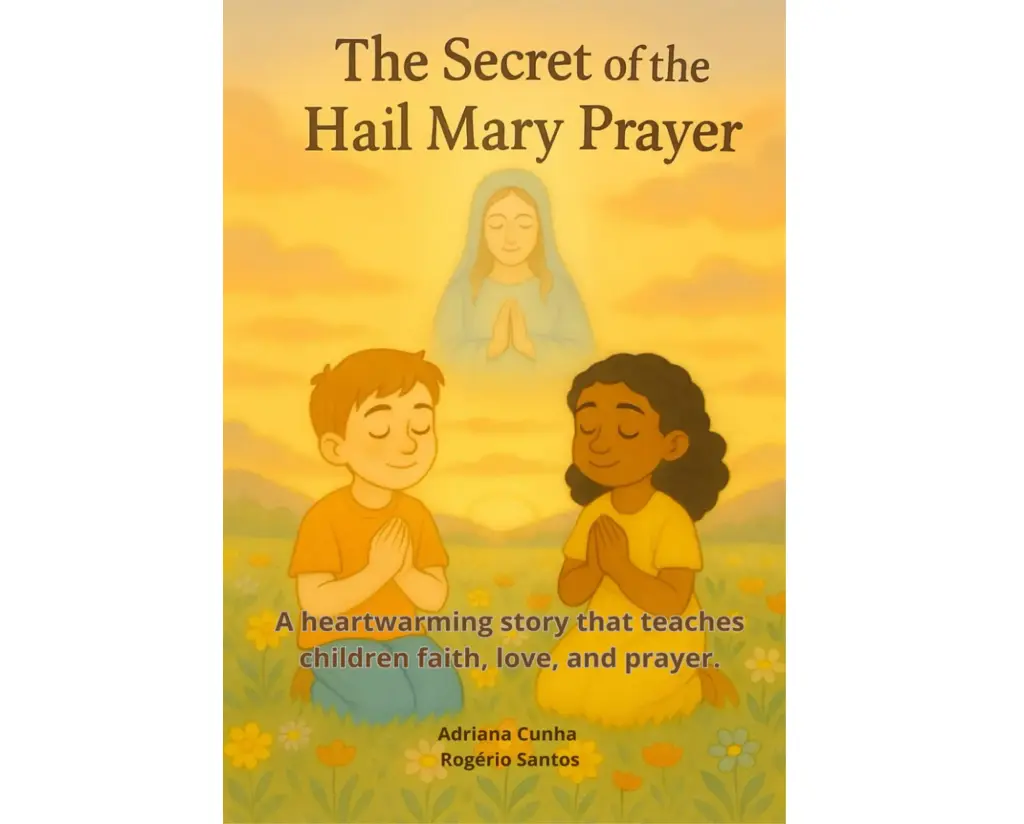
The Secret of the Hail Mary Prayer
An illustrated introduction to the Hail Mary for children ages 4–10, by Adriana Cunha and Rogério Santos.
Read it together alongside this guide, pausing to talk about the prayer and what it means in your family’s life.
Begin With One Person Tonight
Invite your child to name someone who needs encouragement. Pray directly to God, explain how Catholics ask Mary for her prayers, and choose one kind action together.
Learning to pray for others can help children practise care, attention and love.
Background for Parents and Catechists
Bible passages: Luke 1:26–38; John 2:1–11; James 5:16; 1 Timothy 2:1–5.
For the Catholic distinction between devotion to Mary and worship of God, see the Catechism of the Catholic Church, paragraphs 969–971. For prayer with Mary and the Hail Mary, see paragraphs 2675–2677.